

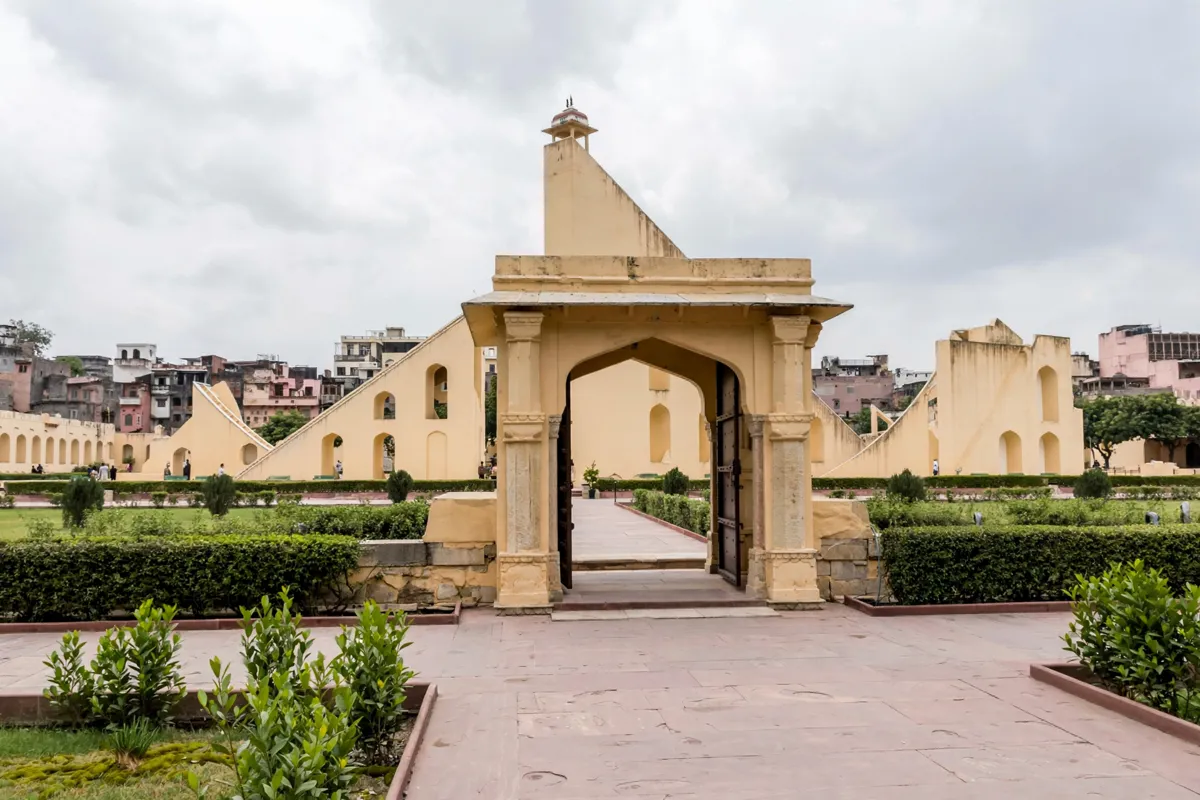
On Jaipur’s eastern side of the walled city, Jantar Mantar is an open-air astronomical observatory where monumental instruments made the sky easier to study. Built by Maharaja Sawai Jai Singh II and completed in 1734, it used carefully designed structures to track time and the Sun.
- Location: Jaipur’s walled city.
- Stay: Rawla Mrignayani Palace offers three-star hotel rooms.
- What to see: instruments including the Vrihat Samrat Yantra, Chakra Yantra and Digamsa.
- Admission: ₹50 for Indian visitors and ₹200 for foreign visitors; confirm current details before your visit.
Why was Jantar Mantar built?

Jantar Mantar was built to observe and calculate astronomical movements using large, purpose-designed instruments. Maharaja Sawai Jai Singh II commissioned the observatory, completed in 1734. It is one of five observatories he built, and Rajasthan Tourism describes it as the largest.
The site is a UNESCO World Heritage Site. Its scale is part of the point: rather than relying only on small handheld tools, the observatory’s structures served as instruments for making observations. As you walk through the grounds, look at how each structure’s shape and orientation relate to its astronomical purpose.
What do the instruments measure?

The instruments at Jantar Mantar measure time and aspects of the Sun’s position. Official descriptions give the count as 16 to 19 instruments or geometric devices.
Vrihat Samrat Yantra
The Vrihat Samrat Yantra is a 27-metre-long sundial that calculates time to an accuracy of two seconds.
Chakra Yantra
The Chakra Yantra measures the Sun’s coordinates and hour angle.
Digamsa and Nadivalaya
Digamsa is used to predict the day’s sunrise and sunset times. Nadivalaya consists of two circular plates facing north and south, symbolising Earth’s two hemispheres.
An Interpretation Centre at the site explains the observatory’s working principles and chronology. It can add context to the instruments you see outside.
How do you plan a visit to the observatory?

Start by deciding whether to explore independently or use an audio guide or a hired guide. Both guide options are available. The open-air instruments are the main focus, while the Interpretation Centre offers background on how they work.
Opening hours
- Monday to Sunday: 9:00–18:30
Last checked November 2026. Hours can change on holidays and for special events.
From Rawla Mrignayani Palace, Jantar Mantar is about a 16-minute walk or a 6-minute drive. Pair the visit with nearby City Palace as part of a walled-city outing. For a wider route, a one-day Jaipur itinerary through the Old City can help you think about how to arrange stops.
What are the tickets, hours and visitor options?
Rajasthan Tourism gives admission prices of ₹50 for Indian visitors and ₹200 for foreign visitors, with tickets available at the entrance or online. It gives entry hours as 9:00 AM to 7:00 PM, with the last ticket issued at 6:30 PM. India’s official tourism portal gives different closing hours, listing 9:00 AM to 5:00 PM.
Because published hours differ and ticket details can change, check the Rajasthan Tourism official site before you go.
Can you pair Jantar Mantar with City Palace?
Yes. City Palace and Jantar Mantar are both Jaipur attractions within the walled-city setting, so you can plan them as part of the same outing. The City Palace is located deep within Jaipur’s walled city; check its arrangements separately when planning your day. Hawa Mahal is another Jaipur monument to include in a wider Old City plan.
For the palace’s history and visitor details, this guide to City Palace Jaipur covers its visitor details. Keeping the two visits together gives you a focused look at Jaipur’s historic centre without needing to treat the observatory as a standalone excursion.
FAQs
What is Jantar Mantar Jaipur?
It is an astronomical observatory built by Maharaja Sawai Jai Singh II and completed in 1734. The site is a UNESCO World Heritage Site.
How many instruments are at Jantar Mantar?
Official descriptions give counts ranging from 16 to 19 instruments or geometric devices.
Can you buy Jantar Mantar tickets online?
Tickets are available online or at the entrance. Check current ticket details before visiting.
Are guides available at the observatory?
Yes. Visitors can hire a guide, and audio guides are available.